



Chessigma / Chess Sigma Review: Free Analysis, Froggy, Pricing, and Alternative
This Chessigma review answers the real search questions first: Chessigma is legit, its free analysis tool is good, and its paid Supercoach tier is a real shipped product. Searchers also write the brand as "Chess Sigma," so this page covers that spelling too: the product is Chessigma, but the buying questions are the same. We rechecked Chessigma's homepage, analysis board, pricing page, and Supercoach page on September 7, 2026, because the search demand is practical: people want to know whether Chessigma is good, free, safe, cheaper than Chessvia, and worth paying for.
If you're comparing Chessigma vs Chessvia, the choice is not "real engine or fake engine." Both run serious chess analysis. The split is whether you want a fast report and training dashboard, or a coach you can question on the exact position until the mistake makes sense.
Full disclosure before we go further: Chessvia is our product. So read this as our honest comparison, not a neutral referee's scorecard. We've tried to be fair to Chessigma, because it earned its users, and we'll tell you plainly where it beats us. In a couple of places, it does.
Quick answer for the Chessigma review searcher:
- Chessigma / Chess Sigma review: same product, two spellings. The company styles it Chessigma; people searching "Chess Sigma review" usually want the same free-analysis, safety, pricing, and alternative answers.
- Chessigma free analysis: strong. The no-signup Stockfish report is the main reason people find it.
- Chessigma analysis board: also real. Their public analysis board runs Stockfish 17 in the browser, takes PGN or FEN, and keeps the current FEN in the URL for sharing.
- Froggy / Supercoach: real and paid. Current public copy lists $14/month founding pricing, $97/year, $340 lifetime, and Froggy message caps that start at 200 coach messages per month on the monthly plan.
- Best Chessigma alternative: choose by job. Lichess for raw free engine lines. Chessvia when you want the move explained in plain English and a coach you can question on the same board.
Picture the two use cases. If you want a fast, free, no-signup report on a game you just played, Chessigma is hard to beat. If you want to understand why a move failed, in plain language, and keep asking follow-ups until it clicks, that's where Chessvia comes in.
If you already know you want the coaching path, skip the comparison and start free. Bring a game you were confused by, then ask the coach why the key move failed.
Start free with ChessviaChessigma analysis: what you actually get for free
The free Chessigma analysis path has two pieces. The homepage lets you review a full game from Chess.com, Lichess, or PGN. The separate Chessigma analysis board lets you paste a PGN, jump to a FEN, or play moves from scratch while Stockfish 17 evaluates the position in your browser.
That matters because a lot of "free chess analysis" pages are only lead magnets. Chessigma's analysis board is not that. It shows the engine evaluation, principal variation, depth, move tree, and a shareable FEN URL without making you create an account. If all you need is a raw Stockfish board, Chessigma belongs in the same practical shortlist as Lichess.
The limit is not engine strength. The limit is explanation. Chessigma's free analysis can show you the best line and a move grade. If you want the mistake explained in plain English, that moves you into either the paid Froggy/Supercoach tier or a tool like Chessvia, where the explanation and follow-up questions are the main product.
Chessigma review: the short version
- Is Chessigma legit? Yes. It runs Stockfish 17 in the browser for the free report, and its paid Supercoach tier is live.
- Is Chessigma good? Yes, especially if you want quick no-signup reports, metrics, drills, and a structured training dashboard.
- Is Chessigma free? The game analysis report and analysis board are free. The DNA report, daily plan, drills, Bot Challenge, and Froggy coach live in the paid Supercoach tier.
- Where does Chessvia fit? Use Chessvia when the report tells you what went wrong but you still need a coach to explain why on the same board.
Chessvia vs Chessigma, feature by feature
Both tools run a real engine. Both now have a live AI coach, so let's clear that up right away. Chessigma's coach, Froggy, is a 200 messages a month capped chat that sits inside a metrics-and-drills app. Chessvia is built around the conversation itself. Ask why on the exact position, push back, get an engine-checked answer, and play a full game with the coach talking as you go.
The table below is the honest side-by-side. Chessigma's "yes" cells are real, so we haven't dressed them down.
| What you get | Chessigma | Chessvia |
|---|---|---|
| Free game analysis | Yes. Unlimited Stockfish 17 reports, no signup, runs in your browser | Free game review plus a first game against the coach, no account needed |
| Real engine under the hood | Yes, Stockfish 17 (client-side WASM) | Yes, coaching checked against a real engine |
| Live AI coach | Yes, Froggy, capped at 200 messages a month | Yes, Chessy, ask follow-ups on the same board |
| Explains the why in plain language | Through Froggy on the paid plan | Built into the free game review, not an add-on |
| Push back on the exact position | Capped chat inside the app | Yes, ask "why not the knight instead" and it answers |
| Plays a full game with you | Bot Challenge, a paid training module | Yes, play the coach with live in-game commentary |
| Platform imports | Chess.com today for Supercoach; Lichess and PGN marked coming soon | Chess.com, Lichess, and PGN review paths are the product center |
| Two-way voice and persistent memory | No public shipped claim | Early access, not shipped yet |
| Signup to start | No signup for the free report | No account for your first game or review |
| Paid price | $14/mo founding monthly, $97/yr, or $340 lifetime | Silver $7/mo (~$5/mo annual), Gold $14/mo (~$10/mo annual), Platinum $19/mo ($149/yr) |
Two things worth saying out loud from that table. Chessigma is cheaper on an annual plan and offers a lifetime option we don't. And on the engine and the free report, it's excellent. The place the two products genuinely split is the last few rows: whether the coaching is a capped chat beside a report, or the thing you're actually using.
We re-verified Chessigma's homepage, analysis board, pricing page, and Supercoach page directly on September 7, 2026. The public pages describe free Stockfish 17 analysis, PGN and FEN analysis-board paths, Supercoach/Froggy as a paid live coach, $14/month founding pricing, $97/year, $340 lifetime, and Froggy message caps starting at 200 per month on the monthly plan. If you're reading this months later and a number looks off, check their live page before buying either product.
What Chessigma does well
Let's give Chessigma its due, because it deserves it. Its free analysis tool is the real thing. Paste a PGN, load a FEN, or review a game from Chess.com or Lichess, and you get Stockfish 17 analysis with no account and no daily quota. That's a legitimately good free product, and it's why people like it.
The paid Supercoach tier adds real depth too. You get a "Chess DNA" report built from up to 1,000 of your games across 233+ numbers split into five categories: blunder severity and recurring patterns, discipline (time pressure, snap moves, flagging), tactical find-rate by motif, how well you convert winning positions, and opening prep depth. A daily 15-minute training plan pulls from that data.
The paid plan is not just chat. Current public copy lists a Chess DNA report, daily 15-minute plan, Blunder Fix, Blunder Shield, Woodpecker, and Bot Challenge. It also says Supercoach works with Chess.com today, while Lichess and PGN import are still coming soon.
Froggy, the coach, answers in natural language against your own numbers and boards. None of that is vaporware. It's shipped, and you can buy it today.
Who is that built for? Someone who wants a dashboard of their own weaknesses and a training plan that targets it without needing to ask a single question. If you're the type who'll actually open a drill every morning and treat the DNA report like a scoreboard, Chessigma's structure will get you there.
On price, Chessigma undercuts us where it counts for a lot of people. Its yearly plan runs $97, roughly $8.08 a month. There's also a $340 lifetime license, buy it once and you're done. Chessvia has no lifetime tier, and our annual Gold works out to about $10 a month. So if raw cost over a few years is your deciding factor, we're not going to pretend we win there.
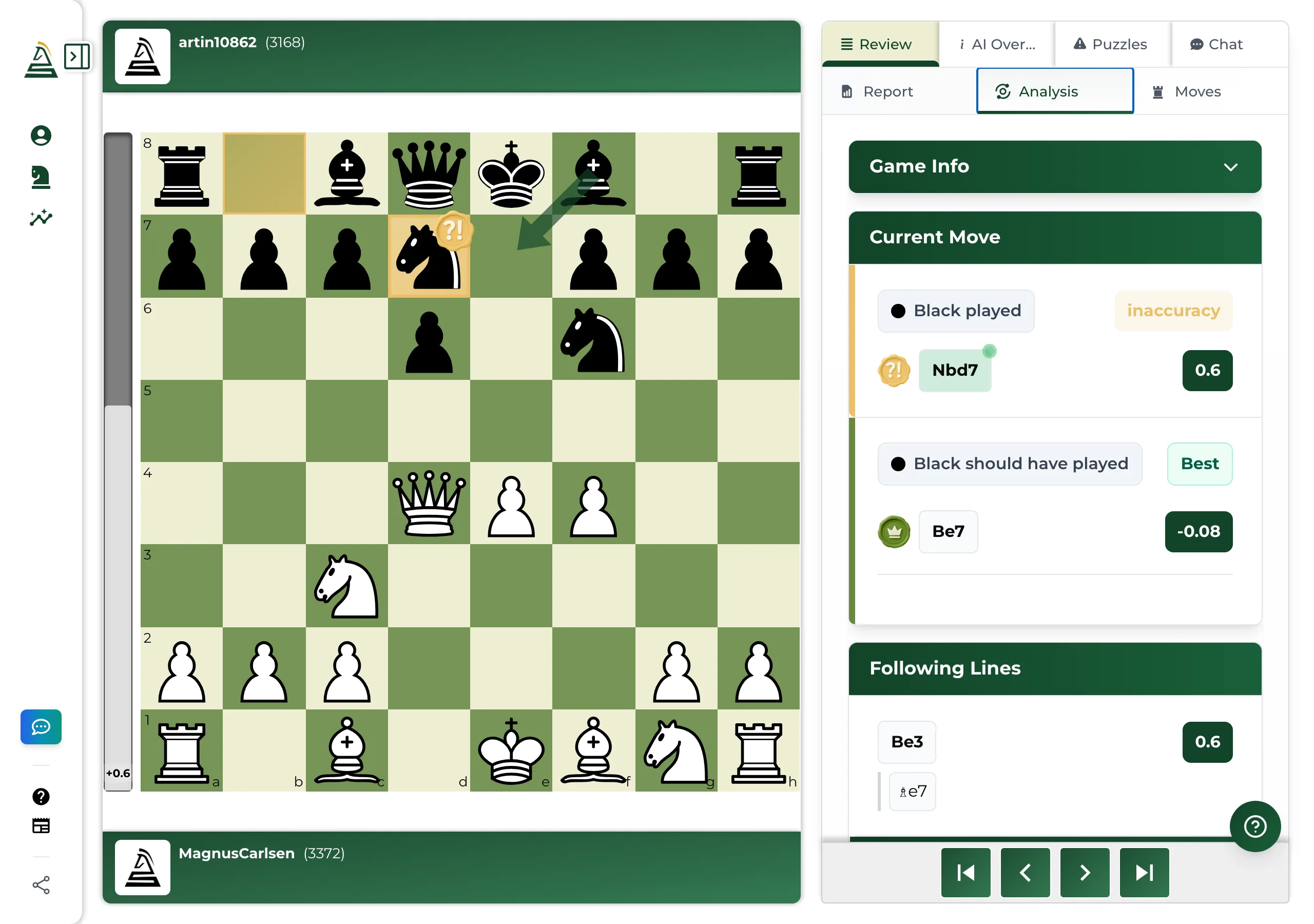
If a quick free report plus metrics and drills is what you're after, Chessigma is a fine pick. We'd rather tell you that than waste your time.
Where Chessvia wins: a coach you can talk to
This is the one axis Chessvia owns. A Chessigma report tells you a move was a blunder and by how much. Useful. But it stops at the number.
Chessvia turns that into a back-and-forth on the same board. You ask why it lost. It answers in plain language, checked against a real engine. And when the first answer doesn't quite land, you push back and ask again.
That "push back" part matters more than it sounds. Say the coach flags your rook move as a mistake. You can ask, "but why not the knight instead?" and get an answer about your actual position, not a canned line. Ask a follow-up on top of that, "what if I'd played it two moves earlier instead," and it keeps reasoning about the same board rather than resetting to a generic tip.
This is the game review that explains why, and it's free to try on a game you've already played. If you want the deeper version of what makes a move count as a blunder in the first place, we wrote about why a move is actually a blunder too.
If Chessigma's DNA report is the dashboard, Chessvia's coach is closer to a study partner sitting next to you. Same underlying engine work, different job. A player who already knows what they get wrong and just wants drills fits Chessigma's shape. A player who doesn't yet understand why they keep hanging pieces in the same kind of position, and wants to interrogate it until it clicks, fits ours.
Then there's the part no analysis-first tool really does: playing. At Chessvia's play page you play a full game against the coach while it talks to you as you go, color-coding your moves and answering questions mid-game. Chessigma's center of gravity is the report and the drills. Chessvia's is the conversation about your move, whether you're reviewing a game or in the middle of one.
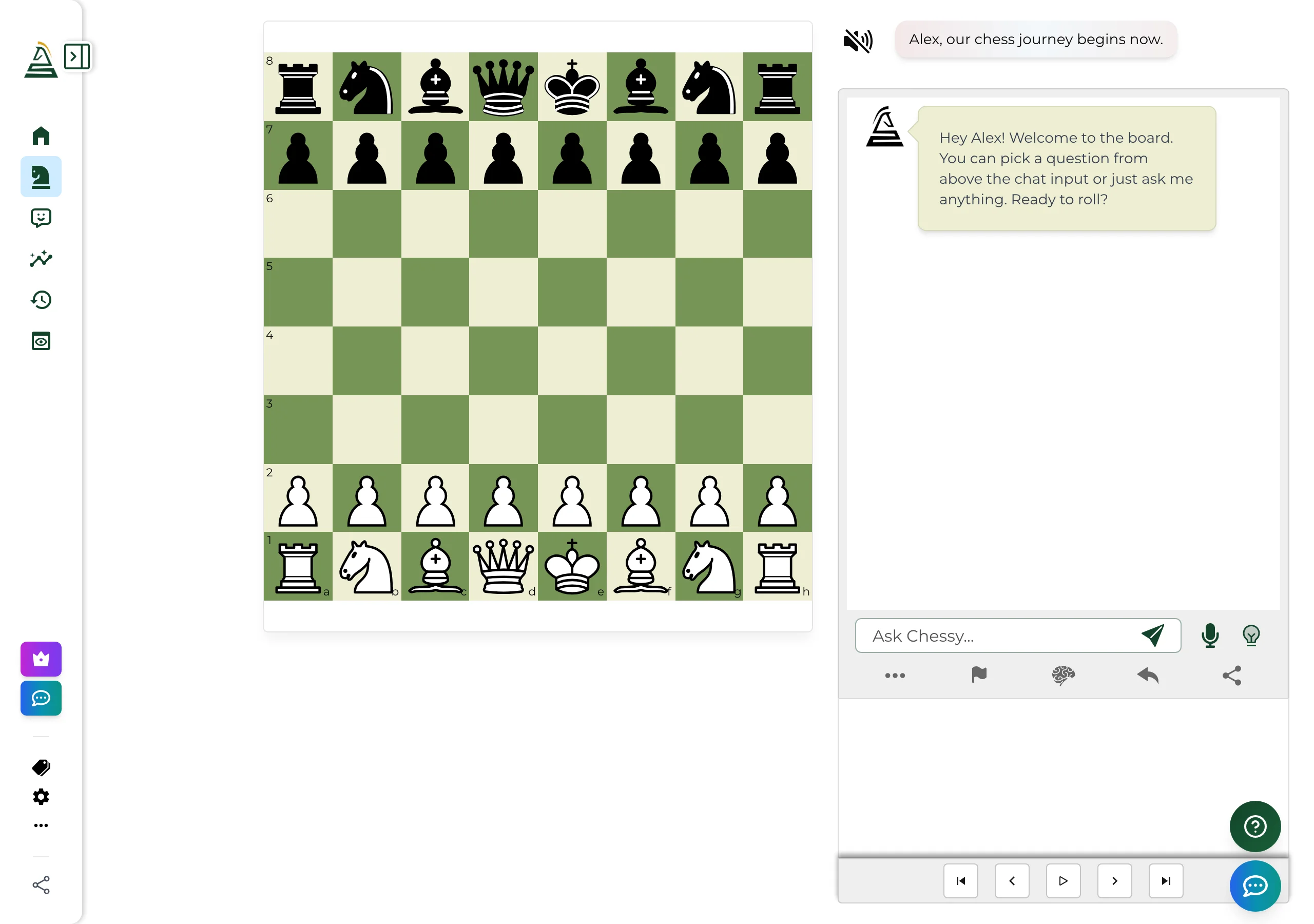
One honest caveat. Two-way voice and persistent memory across sessions are in early access, not shipped. We won't demo them as live, because they aren't yet. The live difference today is the dialogue and the play, both of which you can use right now. If you want the fuller picture of how a grounded coach holds up, here's an honest look at whether an AI chess coach really works.
Which Chessigma alternative should you pick?
By use case:
- Want a fast, free, unlimited report plus metrics, and maybe a lifetime price? Chessigma. It's built for exactly that, and it's good at it.
- Want to understand why a move failed, talk it through, and play a coached game? Chessvia. That's the whole point of the product.
- Not sure? Use both. Plenty of people do. Get the free Chessigma report, then bring the position to a coach you can actually question.
If you just want a raw engine with no explanations and no signup, don't overlook Lichess either. It's free, it's open source, and it'll show you the eval and the best line. What it won't do is tell you why in words, which is the gap both Chessigma's coach and ours are trying to fill.
Already a Chessigma user weighing whether to switch? You don't have to burn what you've built. Keep using the free analysis tool for quick reports, and bring the games where you're genuinely stuck to Chessvia for the conversation. Nothing about Chessigma locks your games in, so there's no migration cost to trying both side by side for a week before you decide.
Comparing more than these two? We keep an honest ranking in our rundown of the best AI chess coaches. Want a closer look at one analysis-first rival instead? Our Chessvia vs DecodeChess breakdown digs into that one.
Same idea across all of them, really. Pick the tool that fits how you actually want to learn, not the one with the loudest homepage.
Want to feel the difference rather than read about it? Start free, then review one of your games and listen to the why.
Start free and review a gameFrequently Asked Questions
Is Chessigma the same as Chess Sigma?
Yes. Chessigma is the product name, but many searchers type it as "Chess Sigma." If you're looking for a Chess Sigma review, pricing, free analysis, safety, or alternatives, you're looking for the Chessigma product reviewed here.
Is Chessigma good?
Yes. Its free analysis tool is one of the better free chess products around: unlimited Stockfish 17 reports, no account, no daily cap. The paid Supercoach tier adds a games-based DNA report, drills, and a live AI coach. If you want a fast free report plus training metrics, it's a strong choice.
Is Chessigma legit and accurate?
It's legit. It runs Stockfish 17, the same open-source engine that powers a lot of serious analysis. If its evaluation of a position differs from Chess.com's, that's almost always down to engine version and search depth, not a red flag. Different engines at different depths give slightly different numbers. That's normal, not a sign the tool is broken.
Is Chessigma free?
The analysis tool and analysis board are fully free, with no signup and no daily limit. The paid Supercoach tier ($14/mo, $97/yr, or $340 lifetime) is what adds the DNA report, the drills, and the Froggy coach, capped at 200 AI messages a month.
Is there a free alternative to Chessigma?
A few. Lichess gives you a free raw engine analysis, though it shows evals and lines rather than explanations. Chessvia's game review is free to try and explains the why in plain language. And Chessigma's own free tool is genuinely one of the best free options for a quick report.
Is Chessigma cheaper than Chessvia?
On an annual or lifetime plan, yes. Chessigma is $97 a year or $340 for life. Chessvia has no lifetime tier and our annual Gold is about $10 a month. We win on the coaching conversation and playing with the coach, not on price, and we'd rather be straight with you about that.
Does Chessvia explain moves like Chessigma?
It goes further. Chessigma's free report gives you the classification and the number. Its plain-language coaching lives in the paid Froggy chat. Chessvia's free game review explains the why directly, and you can ask follow-ups on the same board until it makes sense. That two-way part is the core of what Chessvia does.
How current is this pricing comparison?
We last checked Chessigma's public homepage, analysis board, pricing page, and Supercoach page on September 7, 2026. Chessigma listed $14/mo founding pricing, $97/yr, or $340 lifetime, with Froggy message caps starting at 200/month on the monthly plan; Chessvia Gold was $14/mo or about $10/mo annually. Prices move, so check both companies' pricing pages directly before you buy either.
See you on the board, friend.