



Chess AI Coach: Board-Specific Help Without the Guesswork
You lose the thread in a position. Too many candidate moves. No idea which one actually holds the advantage. So you look for chess help, and most tools give you one of two things: a best-move arrow with almost no explanation, or a chatbot answer that sounds confident without proving it understood the board.
Chessvia is built for the gap between those two. It lets you review your own games, practice against a coach, and ask board-specific questions: why a move failed, what the threat was, whether your plan still works, or what you should be thinking about next. The answer is checked against a chess engine first, then explained in plain language so you can use the idea again.
Quick answer: the best chess AI coach is not just a move finder. It should turn engine output into a reason you can understand: what changed on the board, what you missed, and how to spot the same pattern next time. Chessvia gives you that review-and-practice loop on your actual positions instead of another generic lesson or raw eval bar.
If by "chess helper" you mean a tool that tells you what to play in a live rated game, skip it. That's cheating, and it will make you worse. The useful version is different: review one of your own positions, ask why a move worked or failed, and turn the answer into a pattern you can spot without help next time.
That gap between an engine's answer and actually understanding it is the whole reason Chessvia exists as an AI chess coach in the first place. A 1400 player doesn't need a fourth decimal on the eval bar. Just one sentence, said plainly: "your knight was undefended the moment you pushed that pawn." That's what a good chess AI coach is for, and it's what Chessvia is built around: plain-language feedback tied to your board, your move, and the idea you can reuse.
Most tools stop at "here's the move." A raw eval number doesn't teach you anything you can reuse next Tuesday. This one goes further: engine-checked answers in a practice or post-game review context, not live rated-game assistance. Using outside help in a rated game is cheating; Chessvia is for learning from positions so your next decision is better when you are on your own.
What that actually looks like, and why it's a different kind of coach than a plain engine or a chatbot guessing at legal moves, breaks down into three things.
Learn Chess With Board-Specific Feedback
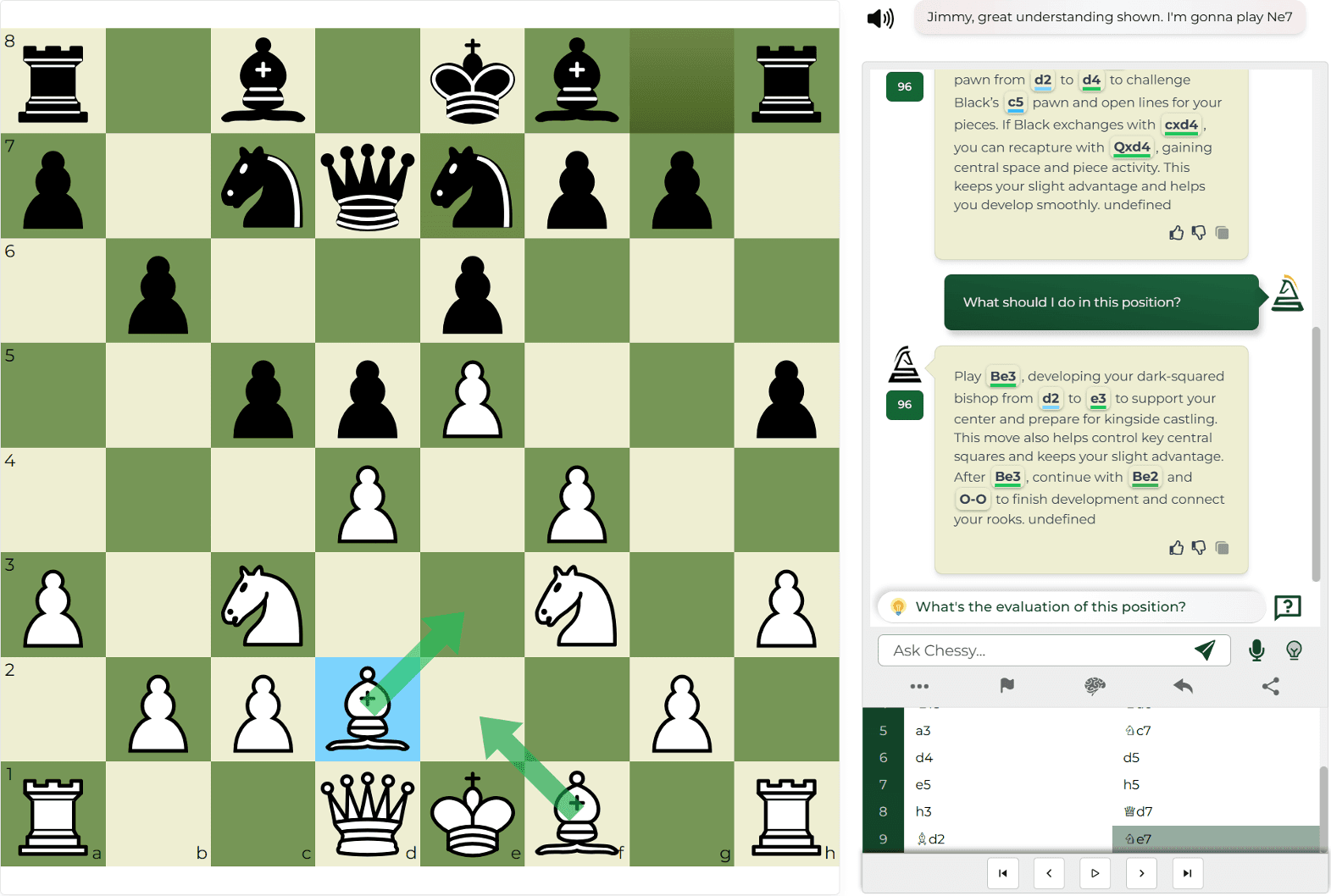
Simple idea, really. You ask questions about the position you are studying or the practice game you are playing against Chessy. Not a generic lesson from a book. Stuck? Ask "what's the threat here?" Torn on whether castling was right? Ask that too, right there in the chat next to the board.
Chessy checks a real chess engine first. Then it explains what the engine found, in language tailored to your rating and to the specific mistake you just made, not some one-size-fits-all script.
Your moves and Chessy's moves get color coded as you go, so you can see the shape of the game at a glance:
- Brilliant moves show up in teal
- Best moves show up in green
- Mistakes show up in yellow
- Blunders show up in red
See a yellow move and wonder why? Click it. Ask. Chessy walks through what you missed and what you should've played instead, tied to that exact position, not a generic tip pulled from a list.
One small thing that matters a lot more than it sounds like it should: any move or piece Chessy talks about also lights up directly on the board itself. You're not translating a paragraph of text back into a mental image while three variations are fighting for space in your head mid-game. The board just shows you.
What Asking Actually Looks Like
Feature lists only get you so far. Two real exchanges instead.
First one: you push a pawn, the engine flags it yellow. You ask Chessy why. A generic tool just says the eval dropped. Chessy says the pawn you just pushed stopped defending your knight, and your opponent already had a bishop aimed at that square, so the knight's about to fall. Should've defended it first. That's the whole answer, and it's a pattern you'll recognize next time before it happens.
Second one: no obvious plan on the board, nothing jumps out. "What should I be thinking about here?" Instead of one best move, you get a read on the whole position: which side is open, whose king is safer, what the next few moves are actually building toward. Not "play Nf3." Something you can carry into a completely different game next week, because it's about the idea behind the move, not the move itself.
And the questions don't reset each time. "What if I'd played the other knight instead?" doesn't need you to re-explain anything. Chessy already knows what's on the board, and it'll walk through that alternative the same way, engine-checked, not guessed at.
How Chessy Stays Grounded
Try this sometime: ask a raw chatbot about a chess position. It'll answer with total confidence whether or not the move it just described is even legal. Language models don't hold a board in their head. They predict likely-sounding words. And "likely-sounding" isn't the same thing as "true" once you're talking about an actual position on a board.
Chessy works the other way around. Engine first, language second. The position gets evaluated, and only then does the explanation get built from what the engine actually found there. Doesn't make every response perfect (the real numbers on that are here, we're not going to pretend otherwise), but it means the answer traces back to a calculated position instead of a guess dressed up as one. Curious how the engine-then-language pipeline actually works? This breaks it down.
Why does the order matter so much? Because a wrong answer does the most damage exactly when you're most likely to trust it: mid-game, already uncertain, looking for someone to just tell you what's going on. A confidently wrong explanation there doesn't just cost you one game. It teaches you the wrong lesson, and that lesson rides along into the next ten games until something finally corrects it.
Same reason the answers actually change with the position instead of recycling five stock phrases. Ask a generic tip generator anything and you'll hear "control the center" by the third question. An engine-grounded coach tells you why the center matters here, in this game, or why it stopped mattering two moves ago once the position closed up.
Customize Your AI Chess Experience
The Q&A is the core. But give it a few games and most users start tweaking things around it:
- Personality: Grandmaster, Hustler, Roasty, or build your own from scratch
- Difficulty that actually matches you: Chessy plays at your level using the Maia models out of the University of Toronto, trained on millions of real human games rather than pure engine play — their published research puts it at predicting the exact human move over 52% of the time
- Import games from chess.com or lichess so the analysis is based on your actual games, not a generic sample
- Over 30 languages. Ask in one, get the answer back in the same one
- Ask the same question a lot? Save it as a shortcut
- Board theme, pieces, and a handful of other settings, the small stuff that makes it feel like yours
You don't need to take our word for any of this. Play your first game against Chessy right now, free, no account required. Or if you'd rather start from a finished game, analyze one for free and read the plain-language review before you decide whether the coaching loop is useful.
Who This Is Actually For
Not every rating band uses this the same way, and it's worth being honest about that instead of pretending one tool fits everyone identically.
Under 1000? Mostly one-move blunders, and getting them explained plainly and clearly, right after they actually happen. You don't need positional nuance yet. You need "you left your queen undefended" said clearly enough that it actually sticks the next time.
1000 to 1800 is where it gets interesting. Not just "what was the mistake" anymore, but "what should I have been thinking about instead." A single answer rarely closes the loop at this level, so the follow-up questions start doing real work. Ask, get an answer, that answer raises a second question, ask that too. Chessy holds the thread instead of resetting every time you type.
Above 1800, most players already know what a "good move" looks like on sight. What they're actually missing is the reasoning behind the subtler stuff: why one reasonable plan beats another equally reasonable one, or why a plan that was working three moves ago quietly stopped. Harder question for any tool, engine-grounded or not. But it's exactly the kind of question a plain eval number can't touch.
Frequently Asked Questions
What is an AI chess helper?
An AI chess helper is a tool that uses chess analysis to explain a position, suggest ideas, or help you understand a mistake. The useful version is not just a move arrow. It should tell you why the move matters, what changed on the board, and what pattern you can recognize next time.
Chessvia does that through a live coach interface: ask a question during a game, get an engine-grounded answer, and see the relevant board idea instead of translating a static report by yourself.
How do I get better at chess with AI?
Practice against adaptive AI that matches your level and actually explains why a move works or doesn't. That's the fast way. Memorized lines fall apart the second your opponent goes off-script. A pattern you actually understand doesn't.
Tools like Chessvia let you ask questions mid-game instead of reading a report twenty minutes and three games later, once the position's gone cold in your head.
Can I ask Chessvia's AI coach questions while playing a game?
Yes. You can ask Chessy questions like "what's the threat here?" or "why did you play that move?" mid-game and get an answer right away, tailored to your rating.
Most game-review tools only give you feedback after the game ends, once the position that confused you is long gone. Chessy is built for the moment you're actually deciding, while that confusion is still sitting right in front of you on the screen.
How is Chessvia different from Chess.com's game analysis?
Chess.com's game review does explain some of what went wrong, that part's real. What it doesn't do is take a follow-up question. You read the report after the game, once, and that's it. If the explanation doesn't fully click, there's nowhere to push.
That's the gap Chessy fills: ask about a move mid-game, while you're still deciding, not after the result's already locked in. Get an answer, then ask "why not the other knight" and get a real answer to that too, back and forth, until it actually makes sense. Want the deeper version of this idea? Here's why a move actually counts as a blunder, backed by hundreds of thousands of engine-graded moves.
How is Chessvia different from Stockfish or regular chess engines?
Stockfish hands you the best move and a number, and that's the whole answer, take it or leave it. Chessvia takes that same output further, explaining why it's best in language you'll actually use next game, and it'll take a follow-up question if the first explanation doesn't fully land.
Getting the answer to a math problem versus actually learning how to solve it yourself. One gets you through tonight's single game. The other gets you through the next hundred.
Do I need to be a strong player to use an AI chess helper?
Not at all. If anything, beginners get the most out of it. Every mistake gets flagged and explained the moment it happens, and that builds pattern recognition a lot faster than reviewing your own game later and guessing whether you actually got it right. Adaptive difficulty plus color-coded feedback means it scales down just as easily as it scales up. You're not handed the same dense output a 2000-rated player gets.
Ready to Try It?
Head to chessvia.ai/play and start a game. No account, no setup. Just a board and a coach willing to answer whatever question you actually have, not the question a static report assumed you'd ask. Ask it something mid-game, watch the board light up with the answer, and see for yourself whether real-time coaching actually changes how a game feels to play.
Play Your First Game Against the AI